Top attractions:
About Bergamo
So, what’s the deal with Bergamo? Well, for starters, this place is old. Like, really old. It has a history that dates back at least to Roman times, and there are plenty of historical sites and landmarks that have been preserved and are open to visitors today. Bergamo can offer much more then just the 3rd busiest airport in Italy.
The most exciting part is Città Alta (“Upper Town”). It is the medieval and Renaissance hilltop core of Bergamo, a city in Lombardy about 40 km / 25 mi northeast of Milan. Perched at roughly 366-380 m / 1,200-1,250 ft above sea level, it sits apart from the modern Città Bassa (Lower Town) on the plain below, connected by a historic funicular railway. The whole quarter is ringed by the Venetian Walls, a 16th-century defensive circuit nearly 6 km / 3.7 mi long that today forms part of a UNESCO World Heritage Site.
Inside the walls, narrow cobbled lanes converge on Piazza Vecchia, widely considered one of Italy’s finest squares, then continue past Piazza del Duomo’s cluster of churches to quieter corners like Colle Aperto and the San Vigilio hill. Because cars are largely restricted, Città Alta is best explored on foot, and most sights sit within a 15 to 20-minute walk of each other.
Despite its museum-like appearance, Città Alta is a lived-in neighborhood. Locals shop at the covered market, students fill the university buildings near Piazza Vecchia, and residents still crowd the bars around Via Colleoni for evening aperitivo. This mix of everyday life and centuries-old architecture, shaped in turn by Romans, Lombards, and the Republic of Venice, is what gives the upper town its distinct character.
Bergamo Details
- Location: Foothills of the Orobie Alps, Lombardy, northern Italy
- Region: Province of Bergamo, Lombardy, Italy
- Postal codes: 24121-24129
- Distance from Milan: Approx. 40 km / 25 mi northeast
- First mentioned: Roman municipium of Bergomum, 49 BC
- Population: ~122,000 (as of 2025)
- Area size: 40.16 km² / 15.51 sq mi
- Elevation: 249 m / 817 ft (city reference); Città Alta rises to approx. 366-380 m / 1,200-1,250 ft
- City structure: Città Alta (Upper Town, historic hilltop core) and Città Bassa (Lower Town, modern center on the plain)
- Main squares: Piazza Vecchia (Città Alta); Piazza Vittorio Veneto and Piazza Matteotti (Città Bassa)
- UNESCO status: Venetian Walls in Città Alta, part of “Venetian Works of Defence between the 16th and 17th Centuries,” inscribed 2017
- Airport: Il Caravaggio International Airport (Orio al Serio), approx. 5 km / 3 mi southeast
- Train station: Bergamo, Piazzale Guglielmo Marconi 7 (Città Bassa)
- Transport: ATB city buses and funiculars; Autostrada A4 (Milan-Venice); regional trains to Milan, Lecco, and Brescia
- Accessibility: Città Bassa is generally flat and step-free; Città Alta has steep, cobbled streets, though the funicular and main squares are accessible
Location
History of Bergamo
The hill was first settled by the Ligurian Orobii, then taken around 550 BC by the Celtic Cenomani. Rome absorbed the settlement and granted it municipium status in 49 BC under the name Bergomum, laying out streets whose alignment still shapes parts of Città Alta today. After Rome’s fall, the Lombards made Bergamo the seat of one of their duchies from the 6th to 8th centuries, and the town later grew into an independent medieval commune, repeatedly contested by Milan’s Visconti and Malatesta lords.
In 1428, following the Battle of Maclodio, Bergamo passed from Milan to the Republic of Venice, becoming the westernmost outpost of Venetian territory on the mainland. Venice ruled for nearly 370 years, and it was Venetian engineers who, starting in 1561, tore down more than 250 buildings, including the old cathedral complex, to build the massive defensive walls that still encircle the upper town. The mercenary captain Bartolomeo Colleoni, a native of Bergamo who made his fortune fighting for Venice, left his own mark on the town in this period by commissioning the Colleoni Chapel in 1470.
Venetian rule ended with Napoleon’s arrival in 1797. Austrian control followed after the 1815 Congress of Vienna, until Bergamo joined the unified Kingdom of Italy in 1859. The 1887 opening of the funicular finally gave the isolated hilltop an easy link to the expanding lower city and its railway station. In 2017, UNESCO inscribed the Venetian Walls as a World Heritage Site, recognizing Bergamo as the “hill fortification” component of a defense network stretching from Lombardy to Croatia and Montenegro.
Timeline of Important Historical Events
- 550 BC: Celtic Cenomani take the hill settlement from the Ligurian Orobii.
- 49 BC: Rome grants municipium status; the town becomes known as Bergomum.
- 6th-8th century CE: Bergamo serves as the seat of a Lombard duchy.
- 1428: After the Battle of Maclodio, Bergamo passes from Milan to the Republic of Venice.
- 1470: Bartolomeo Colleoni commissions his funerary chapel in Piazza del Duomo.
- 1561: Venice begins construction of the defensive walls around the upper town.
- 1797: Napoleon’s forces end Venetian rule over Bergamo.
- 1859: Bergamo joins the Kingdom of Italy.
- 1887: The Città Alta funicular opens, linking the upper and lower towns.
- 2017: The Venetian Walls are inscribed as a UNESCO World Heritage Site.
Name Origins
The Latin name Bergomum is generally traced to a pre-Roman Celtic or Ligurian root, “berg,” meaning height, fortified place, or dwelling on a hill, a fitting description of the town’s position. In the local Bergamasque dialect, Città Alta and the wider city are still called “Bèrghem.” Some historians also link the toponym to Bergimus, a Celtic deity associated with mountains, though the exact origin remains debated among linguists.
Top 10 Attractions in Città Alta
Città Alta rewards slow walking more than a checklist, but these ten sights cover its essential landmarks, from the main square to the quiet hill above town.
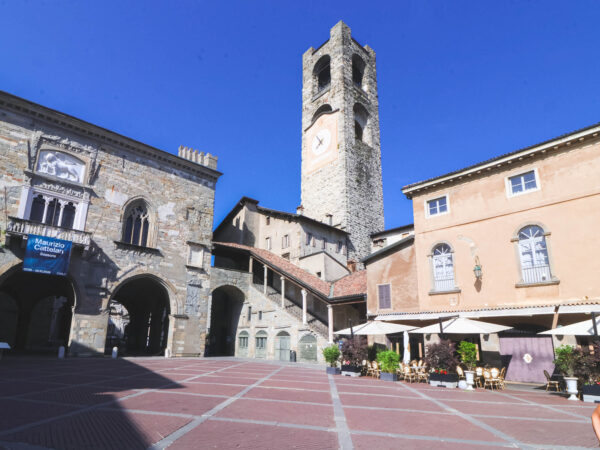
Campanone tower in Piazza Vecchia. Photo by Alis Monte [CC BY-SA 4.0], via Connecting the Dots
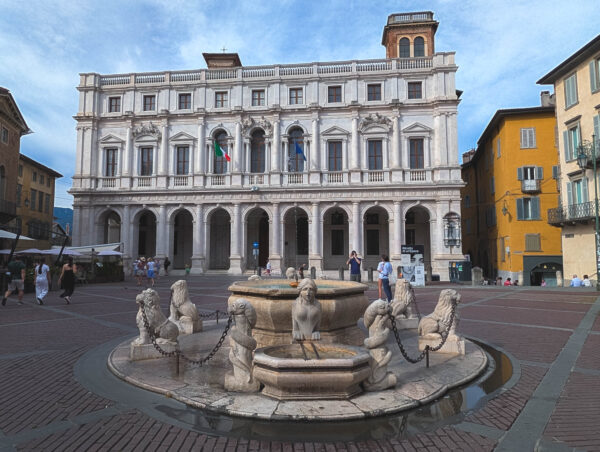
Public library in Piazza Vecchia, Bergamo, Italy
1. Piazza Vecchia
The civic heart of Città Alta since the Middle Ages, Piazza Vecchia is framed by the Palazzo della Ragione, the neoclassical Biblioteca Angelo Mai, and the Palazzo del Podestà. At its center, the Contarini Fountain, a gift from an 18th-century Venetian governor, remains the square’s favorite meeting point and photo spot.
2. Palazzo della Ragione and the Campanone
Bergamo’s 12th-century town hall, Palazzo della Ragione, spans one side of Piazza Vecchia on Gothic arches, with a sundial from the 18th century set into its pavement. Rising behind it, the Campanone (Civic Tower) can be climbed for panoramic views, and every evening at 22:00 it still rings 100 strokes, the same signal once used to announce the closing of the city gates.
3. Basilica di Santa Maria Maggiore
Begun in 1137 in Romanesque style, this basilica hides a lavishly Baroque interior behind its plain stone exterior. Composer Gaetano Donizetti, born in Bergamo, is buried inside beneath an elaborate marble monument, and the choir stalls feature intricate wood inlays based on drawings by Lorenzo Lotto.
4. Colleoni Chapel
Commissioned in 1470 by condottiero Bartolomeo Colleoni as his own mausoleum, this Renaissance chapel stands directly beside the basilica, its facade a striking pattern of red, white, and black marble. Inside, Giovanni Battista Tiepolo’s 18th-century ceiling frescoes crown the tomb of Colleoni and his daughter Medea. Entry is free, though hours can vary seasonally.
5. Bergamo Cathedral and the Baptistery
Dedicated to the city’s patron, Saint Alexander, Bergamo Cathedral (Cattedrale di Sant’Alessandro) sits just off Piazza Vecchia and was largely rebuilt in the 17th and 18th centuries over older foundations. The octagonal Baptistery nearby, originally built in 1340 and later moved to its current spot, adds a smaller Gothic counterpoint to the square’s grander churches.
6. The Venetian Walls
Built from 1561 by the Republic of Venice, the Mura di Bergamo trace almost 6 km / 3.7 mi around Città Alta, reaching up to 50 m / 164 ft in height along the steepest slopes. A walking path along the top of the ramparts offers wide views over the plain and, on clear days, toward the Apennines, and it becomes a car-free promenade for locals on weekends.
7. Rocca di Bergamo and Parco delle Rimembranze
This fortress on Sant’Eufemia hill dates back to the 14th century and was later reinforced under Venetian rule. It now houses a small museum on 19th and 20th-century local history, while the surrounding Parco delle Rimembranze, a memorial park planted after the First World War, offers some of the best skyline views in Città Alta.
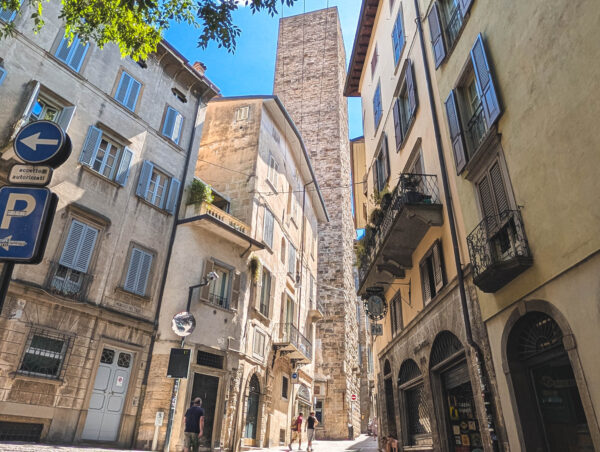
Torre del Gombito. Photo by Alis Monte [CC BY-SA 4.0], via Connecting the Dots
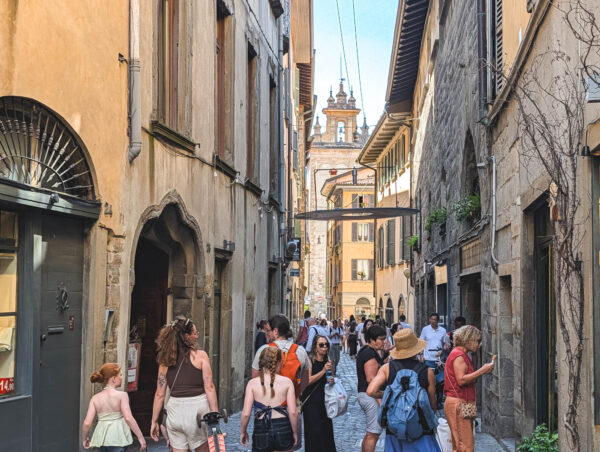
Via Colleoni. Photo by Alis Monte [CC BY-SA 4.0], via Connecting the Dots
8. Torre del Gombito and Via Colleoni
One of the tallest surviving medieval towers in the city, the 12th-century Torre del Gombito marks the start of Via Colleoni, the old town’s main pedestrian artery, historically called the Corsarola. Lined with shops, cafés, and old palazzi, it is the natural route between Piazza Vecchia and the western gates.
9. Cittadella and the Civic Archaeological & Natural History Museum
Built in the 14th century under the Visconti of Milan, the Cittadella fortress now hosts Bergamo’s Civic Archaeological Museum, whose collection traces the area’s history from prehistory through the Lombard period. A natural science museum in the same complex adds exhibits on local geology and wildlife, making it a good rainy-day stop.
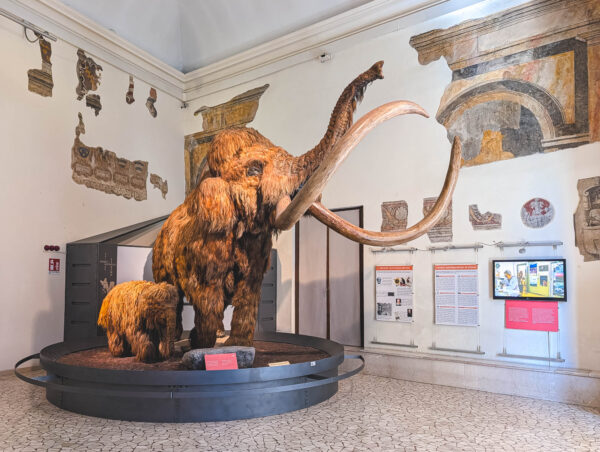
Woolly mammoths stand in the Civic Museum of Natural History. Photo by Alis Monte [CC BY-SA 4.0], via Connecting the Dots
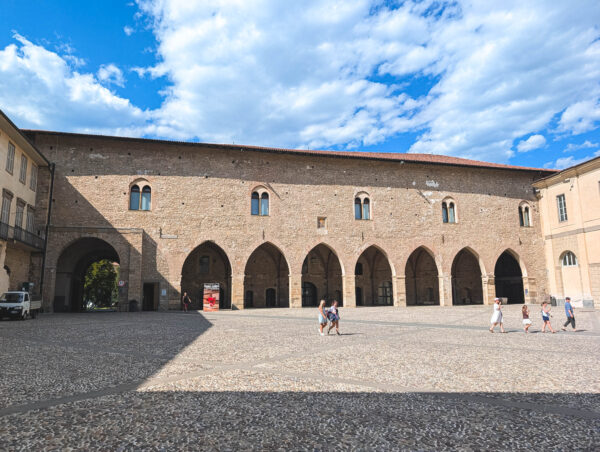
Piazza della Cittadella. Photo by Alis Monte [CC BY-SA 4.0], via Connecting the Dots
10. San Vigilio: Funicular and Castello di San Vigilio
A second, smaller funicular, opened in 1912 near Porta Sant’Alessandro, climbs to San Vigilio hill above Città Alta. At the top, the ruins of the Venetian-era Castello di San Vigilio (built 1550-1600) and a scenic belvedere give what many consider the best panoramic view of the old town and the plain beyond.
Local Cuisine to Try in Città Alta
Bergamasque cooking reflects two traditions meeting in one city: the hearty Alpine dishes of the surrounding valleys and the richer tastes brought in by centuries of Venetian trade. These are the dishes that appear on nearly every menu in Città Alta.
Casoncelli alla Bergamasca
The defining local pasta: hand-folded parcels stuffed with a mix of meat, breadcrumbs, and Grana Padano, sometimes with a sweet twist of crushed amaretti or raisins. They arrive dressed simply in browned butter, sage, and crisped pancetta. The interplay of savory filling and barely-sweet dressing is Bergamo’s culinary signature. Avoid any version swimming in pale, unbrowned butter — that is the tourist-trap tell.
Polenta Taragna
Made from a mix of corn and buckwheat flour, polenta taragna has a coarser texture and an earthier flavor than standard yellow polenta. It is enriched with melted local cheese — typically Branzi or Taleggio — until it pulls into stretchy, golden ribbons. This is a main course, not a side dish, and it is most satisfying from October through March when the mountain chill makes sense of its weight.
Local Cheeses and Salumi
The Orobie Alps above Bergamo produce some of Lombardy’s finest mountain cheeses. Formai de Mut (a semi-hard alpine cheese with DOP status), Taleggio (soft-washed rind, mild and buttery), and Stracchino (fresh and creamy) appear on most antipasto boards alongside cured meats from the valleys. A mixed board with local salami and bresaola makes an ideal first course before pasta.
Polenta e Osei
Bergamo’s signature dessert is a deliberate visual joke: a dome of yellow sponge cake glazed to look exactly like a mound of polenta, topped with marzipan birds (osei). Any bakery in Città Alta sells individual portions. The best versions come from Pasticceria Nessi and Pasticceria Mangili, both near Via Colleoni.
Where to Eat in Città Alta
Trattoria La Colombina on Via Borgo Canale, beside Donizetti’s birthplace, serves a definitive casoncelli with a panoramic terrace — book at least three days ahead for a terrace table. Il Circolino di Città Alta, a cooperative set in a former convent with a shaded pergola, offers a more relaxed atmosphere at the same quality level. For polenta taragna, Trattoria Parietti near San Lorenzo has served Bergamasque classics since 1974. Ol Giopì e la Margì is an institution devoted entirely to the local repertoire. Along Via Colleoni, Locanda Mimmo is a convenient stop after sightseeing — the restaurant downstairs matches the well-regarded rooms above.
Best Accommodation in Città Alta
Staying inside the walls means falling asleep and waking up surrounded by medieval streets, with Piazza Vecchia a short walk from most doors. Rooms are generally smaller than in the modern Città Bassa, and vehicle access is limited, so most guests arrive by funicular, taxi, or a short walk with luggage.
For a special stay, Palazzo Radici occupies a restored historic palace on one of Città Alta’s main streets, with just a handful of suites and views over the Venetian walls and the plain. GombitHotel, a boutique four-star property beside the Torre del Gombito and steps from Piazza Vecchia, is a popular mid-range pick that blends contemporary design with the medieval building’s original details. Hotel Piazza Vecchia, set in Bartolomeo Colleoni’s former 14th-century home right on the main square, offers a more traditional atmosphere at a similar level.
Budget-conscious travelers can look at Al San Lorenzo, a family-run bed and breakfast between the Gombito Tower and Piazza Vecchia, or Locanda Mimmo, with simple rooms above the well-known restaurant of the same area on Via Colleoni. Near the Sant’Alessandro Gate and the San Vigilio funicular, Fuori Porta House suits travelers who want a quieter edge of the old town within easy reach of the bus to Città Bassa and the airport.
Getting to & around Città Alta
Because Città Alta sits on a hill inside a walled perimeter, most visitors leave cars behind and rely on the funicular, buses, or their own feet once inside the gates.
By Funicular
The Città Alta Funicular, opened in 1887, is the classic way up, climbing 85 m / 279 ft in about two minutes from its lower station near Viale Vittorio Emanuele II to Piazza Mercato delle Scarpe inside the walls. Tickets are integrated into the ATB city transport network, so a standard city bus ticket also covers the funicular ride.
By Bus
ATB city buses connect Bergamo’s train station and Città Bassa directly to Colle Aperto at the western edge of Città Alta, useful for visitors with luggage or limited mobility. Airport shuttle buses from Milan Bergamo Airport (Orio al Serio) also stop in the lower city, a short bus or funicular ride from the old town.
By Car
Driving inside Città Alta is discouraged and restricted by traffic limits in much of the historic core. Visitors arriving by car should park in Città Bassa or at one of the designated car parks near the walls, then walk or take the funicular up.
On Foot
Città Alta’s core is compact, and most attractions sit within a 15 to 20-minute walk of Piazza Vecchia. Streets are cobbled and often sloped, so comfortable, sturdy shoes make a real difference, especially on the climb up to Rocca di Bergamo or the walk along the Venetian Walls.
Additional Resources
Planning a trip to Bergamo? Here are some additional resources to help you make the most of your visit:
-
Visit Bergamo – The official tourism website for Bergamo. Here you’ll find information on the city’s top attractions, as well as tips for planning your trip and booking accommodations.
-
Lonely Planet – Lonely Planet’s guide to Bergamo is packed with insider tips and recommendations for exploring the city. You’ll find information on the top sights, as well as advice on where to eat, drink, and shop.
-
TripAdvisor – TripAdvisor is a great resource for finding the best deals on hotels, restaurants, and activities in Bergamo. You can also read reviews from other travelers to help plan your trip.
-
Booking.com – If you’re looking to book accommodations in Bergamo, Booking.com is a great place to start. They have a wide range of options, from budget-friendly hostels to luxury hotels.
-
Bergamo Card – If you’re planning on visiting a lot of museums and attractions in Bergamo, consider getting a Bergamo Card. This card gives you free access to many of the city’s top sights, as well as discounts on other activities and tours.
By using these resources, you can plan the perfect trip to Bergamo and make the most of your time in this beautiful Italian city. Bon voyage!